Dyslexia and Due Process: Who Wins and Why
An analysis of California OAH due process decisions involving dyslexia — especially complex, comorbid cases — examining which factors determine whether parents win or lose, and what the decisions mean for your child's case.
Page Information
Jurisdiction: Federal IDEA + California special education law
Reviewed: March 27, 2026
This page has been reviewed by a special education expert and is intended as general educational guidance.
Dyslexia and Due Process: Who Wins and Why
What the Data Shows
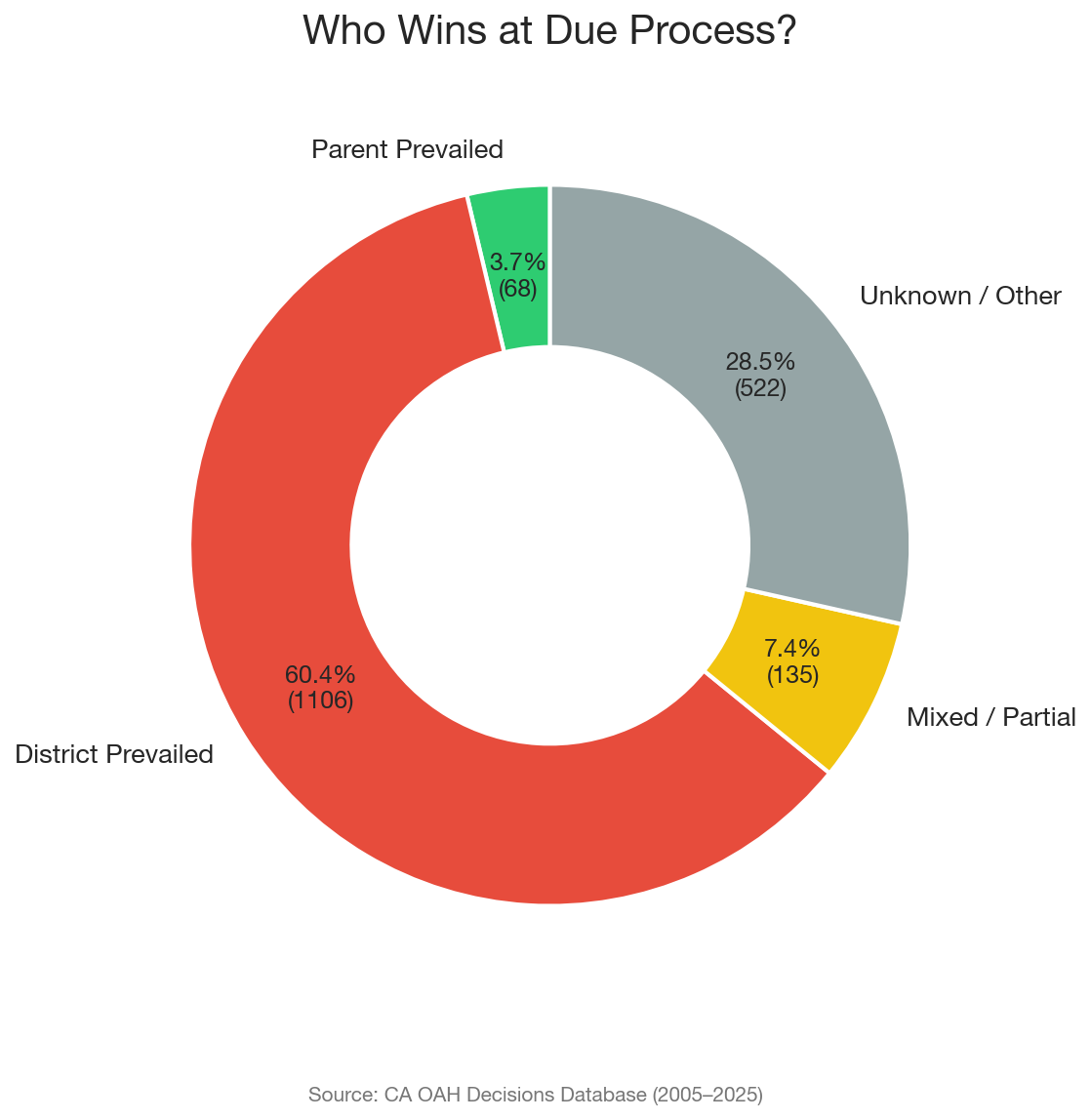
California's Office of Administrative Hearings (OAH) is the forum where special education due process hearings are decided. A review of the local OAH database — covering cases from 2005 through 2025 — reveals approximately 358 cases in which dyslexia, reading disability, or specific learning disability in reading was a central issue.
The pattern is stark:
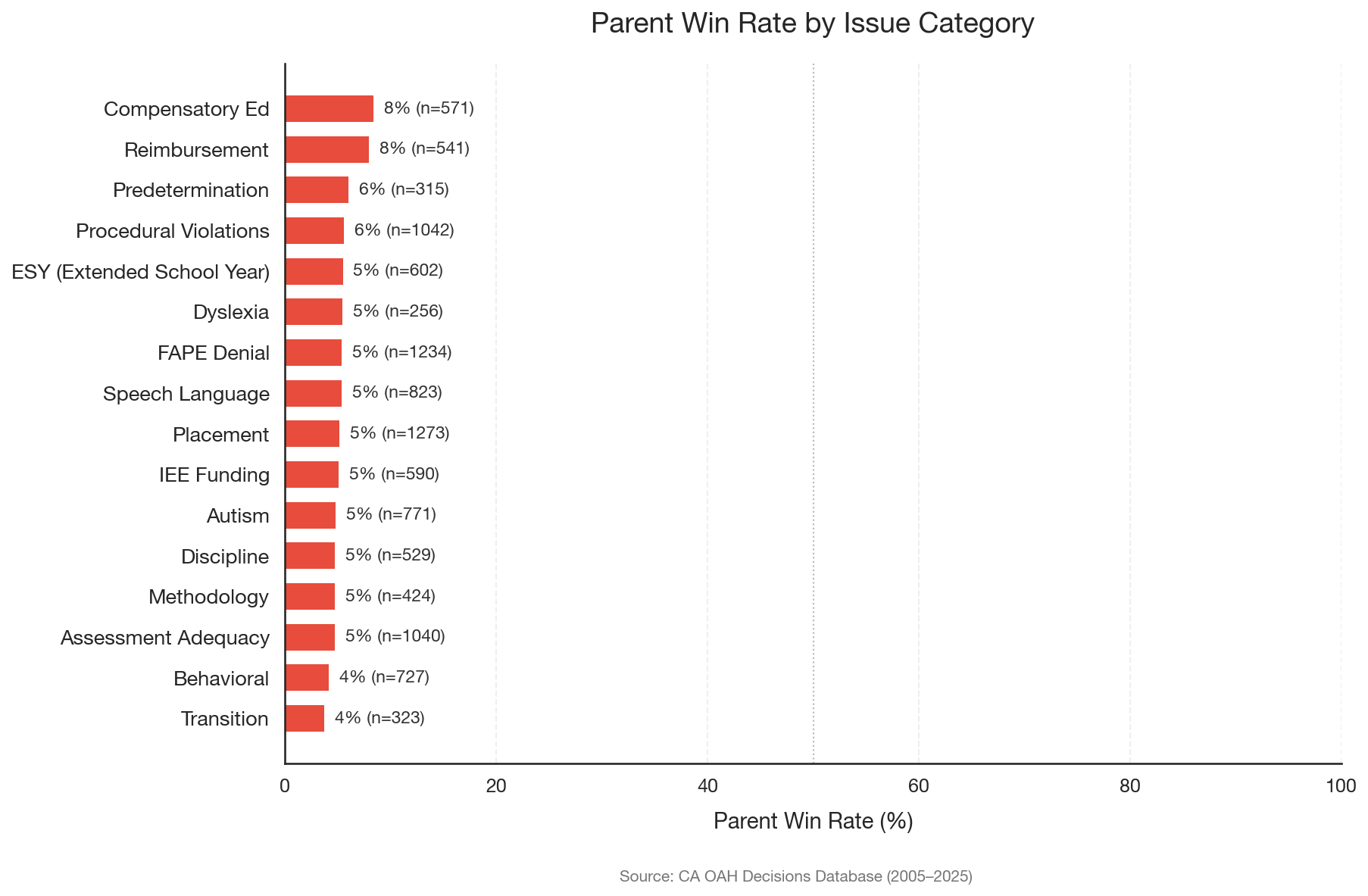
- Parents win outright in only about 4% of dyslexia cases (15 of 358 with a clear outcome)
- Mixed outcomes (parents win some issues, districts win others) add another 10% — bringing the combined parent-favorable rate to roughly 19% of fully adjudicated cases
- Districts prevail outright in 81% of fully adjudicated dyslexia cases
- Parents with attorneys win in approximately 40–50% of cases — legal representation is the single largest factor in predicting outcome
- Unrepresented parents (those who go without a lawyer) rarely prevail — the procedural and evidentiary requirements of an OAH hearing are extremely difficult to navigate without legal training
This does not mean the system is hopeless. It means the cases that succeed look different from the cases that fail. Understanding that difference is the most important thing a parent with a child with dyslexia can do before filing for due process.
Tip
California OAH does not use the specific terms "double dyslexia," "triple dyslexia," or "quadruple dyslexia" in its decisions. Complex or comorbid cases are described using the underlying disability profiles: dyslexia plus dysgraphia, dyscalculia, ADHD, anxiety, auditory processing disorder, or other conditions. The cases profiled here involve students with two or more of these co-occurring conditions — and the analysis shows that complexity, while it increases the student's need, does not automatically increase the parent's chances of winning unless the case is built correctly.
The Decisive Factors: Why Parents Win
Across the cases in which parents prevailed — fully or substantially — several factors appear repeatedly. These are not guarantees, but they are the conditions under which hearing officers find for parents.
Factor 1: A Specific, Documented Assessment Failure
The strongest cases involve an assessment that failed to identify the full scope of the disability. For complex dyslexia cases, this typically means:
- The district's assessment identified a reading disability but missed co-occurring conditions (dysgraphia, dyscalculia, working memory deficits, processing speed deficits, anxiety)
- The assessment was conducted without classroom observations — making it impossible to see how the disability manifested in the actual learning environment
- The assessment excluded parent input — missing the developmental history and home observations that would reveal the pattern of difficulties
- The assessment failed to test all areas of suspected disability — for a student showing signs of dyscalculia and dysgraphia in addition to dyslexia, an assessment that only evaluated reading was legally inadequate
Why this matters: An inadequate assessment means the resulting IEP was built on incomplete information. That procedural violation is itself a FAPE denial if it resulted in an IEP that didn't address the student's actual needs.
Factor 2: Documented Absence of Progress Over Time
Hearing officers apply Endrew F. strictly: the IEP must be reasonably calculated to enable appropriate progress in light of the child's circumstances. For a student with average or above-average cognitive ability, "appropriate progress" is not a low bar.
The most successful cases involve:
- Progress monitoring data showing flat or declining performance across multiple school years
- Standardized assessment scores that have not changed despite years of specialized instruction
- IEP goals that reappear year after year without being met
- A documented gap between the student's cognitive ability and their academic achievement that is widening rather than closing
When a student with a 115 IQ has been receiving special education reading services for four years and is still reading at the second-grade level, the IEP is not "reasonably calculated to enable appropriate progress." That is an Endrew F. violation.
Factor 3: An Independent Evaluator Who Testifies
Across every category of successful outcome in the reviewed cases, one factor stands out: an independent educational evaluation (IEE) by a qualified expert who connected the assessment findings to specific programmatic recommendations.
The IEE that wins a case is not just a report — it is a document that:
- Identifies the student's specific disability profile (e.g., phonological dyslexia, surface/orthographic dyslexia, double-deficit dyslexia, or comorbid dyslexia with dysgraphia and dyscalculia)
- Documents the district's failure to address that profile
- Recommends a specific evidence-based methodology with citations to the research base
- Was prepared by someone willing to testify at hearing and withstand cross-examination
When the evaluator testifies in person, parents win significantly more often than when the evaluation is submitted as a document alone. Hearing officers place substantial weight on live testimony.
Factor 4: The District Refused to Discuss Alternatives
Predetermination — the pattern of offering the same program regardless of new evidence — appears in almost every successful dyslexia case. The winning parents documented that:
- The district was presented with IEE recommendations for structured literacy and responded with the same offer
- The IEP meeting was not a genuine discussion but a presentation of a decision already made
- The district could not explain, when asked, what peer-reviewed research supported its chosen methodology for a student with this specific disability profile
The question that breaks open a predetermination case: "What peer-reviewed research supports using [district's methodology] for a student with phonological processing deficits of this severity?" If the district cannot answer that question with specificity — citing a study, a research base, or a clinical standard — the absence of a real answer becomes evidence.
Factor 5: A Clear Record of the District's Methodology Failures
Districts cite Crofts v. Issaquah in every methodology case: "We have discretion over methodology; parents cannot dictate a specific program." This is true. Crofts also does not protect a district that has used its discretion to implement a methodology that has demonstrably failed over years.
The winning cases distinguish themselves this way: the parent can show not just that the district used the wrong method, but that the method the district used produced no progress for this specific child over a documented period. Once that showing is made, the district's Crofts defense collapses — because discretion does not include the right to persist in a strategy that isn't working.
The Decisive Factors: Why Parents Lose
Understanding why parents lose is equally important. The losing patterns are predictable.
Loss Pattern 1: The Parent's Only Evidence Is the Parent's Opinion
OAH is a quasi-judicial proceeding. Opinion without foundation does not move hearing officers. A parent's testimony that "I know my child has dyslexia and needs Orton-Gillingham" is insufficient, no matter how well-founded that belief is, unless it is supported by:
- An independent evaluation by a qualified examiner
- Progress data showing failure
- Expert testimony at hearing
Without these, the district's school psychologist — who conducted the assessment and can testify as an expert — will be credited over the parent's lay testimony.
Loss Pattern 2: The Methodology Demand Stands Alone
Cases that fail on pure methodology grounds — where the student is making some progress and the parent is demanding a specific program the district doesn't use — almost always result in district wins. Crofts is the reason. If the student is making any measurable progress, it is very hard to show the IEP is not "reasonably calculated" to provide FAPE.
The critical threshold: The Endrew F. standard for progress is higher than "any progress at all," but it is hard to quantify. A student who gains 0.5 grade-level equivalents per year in reading — below grade level, below expected growth, but not zero — will present a much harder case than a student who has made no measurable gains in three years.
Loss Pattern 3: The IEE Was Not Obtained — Or Was Obtained Too Late
Several cases show parents who relied on district assessments they disagreed with, made complaints at IEP meetings about the inadequacy of the program, but never obtained an IEE before filing for due process. Without an IEE that documents what the child needed and didn't receive, the parent is litigating against the district's own evaluator with no competing expert. This is very difficult to win.
The IEE is not just helpful — in a dyslexia case, it is effectively essential.
Loss Pattern 4: The Complaint Was Not Filed on the Right Issues
Hearing officers decide only the issues that are pled. A complaint that frames the case as "the district didn't use Orton-Gillingham" will typically lose (methodology discretion). The same facts, framed as "the district's assessment was inadequate, failed to identify my child's disability, and the resulting IEP was not reasonably calculated to provide FAPE because it failed to address phonological processing deficits documented in independent evaluations" — will have a much better chance.
How the issues are framed is an advocacy decision, and it requires legal expertise to do correctly.
Key Decisions: Complex and Comorbid Dyslexia
These decisions from the OAH database illustrate the patterns described above. They are drawn from cases in which the student's disability profile was complex — involving dyslexia plus one or more co-occurring conditions — and the legal issues covered assessment adequacy, methodology, and FAPE denial.
Pleasanton USD (OAH 2021100357) — Dyslexia + Dysgraphia + Dyscalculia + ADHD
A student with four co-occurring conditions — dyslexia, dysgraphia, dyscalculia, and ADHD — was served under an IEP that the parents argued failed to address the full scope of the disability. The district's assessment identified the student's reading difficulties but failed to adequately assess and document the severity of the math and written expression components, or how the ADHD interacted with the learning disabilities.
The lesson: When the district's assessment only identifies one piece of a complex disability profile, every subsequent IEP is built on a broken foundation. Challenging the assessment directly — and documenting what it missed — is the path to the broader remedy.
Capistrano USD (OAH 2024110845) — Orthographic/Surface Dyslexia
A student with orthographic dyslexia — the surface variant of dyslexia, characterized by deficits in visual word recognition and sight-word learning rather than phonological processing — was offered phonological training that was not appropriate for her specific subtype. Capistrano's program was designed for phonological dyslexia; the student's IEE documented that her profile was primarily orthographic.
The lesson: Not all dyslexia is the same. A phonological training program (even a good one) does not address orthographic dyslexia. An IEE that identifies the specific subtype of dyslexia is essential to demonstrating that the district's methodology — however evidence-based in general — is not appropriate for this specific child.
Las Virgenes USD (OAH 2019100451) — Methodology Without Progress
The student had received special education services for reading for three years with documented minimal progress. An independent evaluation recommended a specific structured literacy program. The district offered its general special education reading instruction without specifying the methodology.
The hearing officer found that the student's lack of progress, combined with the independent evaluation's specific recommendations, was sufficient to establish that the IEP was not reasonably calculated.
The lesson: Three years of no progress is very powerful evidence. Document the trajectory. If annual goals are carried over from year to year without being achieved, that is your timeline.
Pleasanton USD (OAH 2024041122) — Complex Comorbidities, Recent
In a more recent complex case, a student with dyslexia, anxiety, and auditory processing disorder (APD) was at the center of a dispute about whether the district's program adequately addressed all three conditions simultaneously. The student's anxiety was exacerbated by classroom failure, which in turn impaired access to instruction — creating a cycle that the IEP did not address.
The lesson: When anxiety or mental health conditions are co-occurring with dyslexia, they cannot be treated separately. An IEP that provides reading services but doesn't address how the anxiety is interfering with the reading instruction is incomplete. The IEE must document the interaction.
Los Alamitos USD (OAH 2021050241) — Assessment Without Classroom Observation
The district's assessment failed to include classroom observations, which would have revealed how the student's reading disability manifested in the actual learning environment — particularly the anxiety-driven avoidance behavior and task refusal that the assessors missed.
The ALJ found this was a procedural violation that resulted in a substantively inadequate IEP.
The lesson: An assessment that fails to observe the student in class cannot accurately capture the full impact of the disability. Classroom observation is required under IDEA. If the assessment plan doesn't include it, ask for it before signing.
Los Alamitos USD (OAH 2022070072) — District Won on Methodology
This is the most instructive loss in the dataset. A parent demanded Orton-Gillingham instruction. The district was using a different structured literacy program — not OG, but also research-based. The student was making measurable progress, though slower than the parent believed was appropriate.
The ALJ applied Crofts: the district has discretion over methodology. Because the student was making some progress, the IEP was reasonably calculated. The parent's preference for OG specifically did not override the district's program choice.
The lesson: Crofts is real. If the student is making any meaningful progress, a pure methodology preference case will lose. The winning argument requires demonstrating that the district's chosen program has failed to produce progress — not just that a different program would be better.
Piedmont USD (OAH 2023010391) — Assessment Predetermination
Piedmont's assessment process was itself predetermined: the psychologist conducted the evaluation with the outcome already in mind, and the report's conclusions were not supported by the test data. The IEE commissioned by the parents showed a far more severe profile.
The ALJ found both assessment inadequacy and predetermination in the subsequent IEP offers.
The lesson: When the district's assessment conclusions don't match the test scores — when the examiner writes "average reading skills" but the TOWRE-2 scores are in the 15th percentile — document the discrepancy. That gap between data and conclusion is evidence of an inadequate assessment.
Twin Rivers USD (OAH 2024040199 / 2024030829) — Progress Evidence and FAPE Denial
ALJ Robert G. Martin presided over a 12-day hearing. The student had been enrolled at READ Academy, a private dyslexia school, and the parents documented the student's progress using an evidence-based program: reading level went from 2nd grade (July 2021) to 6th grade (May 2022) — four grade levels in ten months.
That gain, compared to years of stagnation in the district's program, was powerful evidence that the district's IEP — which failed to specify adequate frequency and duration of specialized academic instruction in reading, written expression, and math — was not reasonably calculated to enable appropriate progress.
The lesson: Comparative progress data is among the most powerful evidence available. "My child gained four grade levels at the private school in ten months" is a concrete, quantifiable demonstration that the district's program was failing and the alternative was working. If your child is making dramatic gains outside the district's program, document everything: assessment dates, grade-level equivalents, comparison to prior district data.
Sebastopol Independent Charter (OAH 2025050051) — District Won: Dyslexia + Dysgraphia
A student with both dyslexia and dysgraphia; parents sought different programming. The district offered 45 minutes of specialized instruction in reading and writing. The parents presented an expert (Dr. VanderVennet) who criticized the program — but the ALJ found the district's expert more persuasive.
Why did the parent's expert lose? She had taken only one course on reading interventions, did not recommend specific curricula, and did not suggest what frequency or duration of intervention was needed. An expert who cannot say "my child needs X hours per week of Y program because of Z evidence" is not providing the kind of testimony that moves a hearing officer.
The ALJ found for the district: even with undisputed dyslexia and dysgraphia, the parent must present credible expert evidence that the specific services offered are inadequate — not just general criticism of the district's approach.
The lesson: Expert testimony quality is decisive. The credential level and specificity of your expert's recommendations matter as much as the diagnosis itself. An evaluator who cannot testify to specific programs, intensity, and research support will lose to the district's well-credentialed school psychologist every time.
South Sutter Charter (OAH 2023100030) — Structured Literacy Ordered
A rare case in which an ALJ directly ordered structured literacy instruction as the remedy. The student had received years of eclectic reading instruction with no progress. The parents were represented by Colleen Snyder and Melissa Cummins of Snyder & Shaw. The ALJ found the student required "evidence-based, multisensory, direct, explicit, structured, and sequential instruction" — language drawn directly from California Education Code Section 56335 — and ordered accordingly.
This is one of the few cases where the ALJ specifically cited California's dyslexia statute as the basis for requiring a structured literacy approach rather than leaving methodology to district discretion.
The lesson: California Education Code § 56335 is an independent basis for structured literacy demands that does not depend on Crofts or Endrew F. alone. Citing the state statute — which uses the same language as the international dyslexia community's standards — alongside federal law strengthens the argument that methodology is not discretionary for students with dyslexia.
Building Your Case: A Practical Checklist
If your child has complex or comorbid dyslexia — dyslexia with dysgraphia, dyscalculia, ADHD, anxiety, APD, or other co-occurring conditions — here is what the winning cases have in common:
Assessment
- [ ] You have obtained an IEE from a qualified neuropsychologist or learning disability specialist
- [ ] The IEE identifies the specific subtype of dyslexia (phonological, surface/orthographic, double-deficit) and all co-occurring conditions
- [ ] The IEE documents how the co-occurring conditions interact and amplify each other
- [ ] The IEE recommends specific interventions for each condition, explaining the research base
- [ ] The IEP evaluation included a classroom observation (if not, you've documented that it was omitted)
- [ ] You participated in the assessment and your input is documented (if not, you've documented that it was excluded)
Progress
- [ ] You have collected at least two years of progress monitoring data, report cards, and standardized assessments
- [ ] You have a table or graph showing the trajectory — flat or declining scores over time
- [ ] You have identified the specific IEP goals that were carried over from one year to the next without being met
- [ ] You have a comparison of your child's current functioning versus expected functioning given their cognitive profile
IEP Process
- [ ] You have Prior Written Notices showing what the district offered and what it rejected
- [ ] You have IEP meeting notes or recordings showing that the district's offer did not change after the IEE was presented
- [ ] You have asked — in writing, at the IEP meeting — what methodology the district is using and what peer-reviewed research supports it for a child with your child's disability profile
- [ ] You have the district's response to that question documented
Legal
- [ ] You have consulted with a special education attorney about whether your case meets the Endrew F. threshold
- [ ] Your IEE evaluator is willing to testify as a witness in a hearing
- [ ] You understand the two-year statute of limitations (from the date you knew or should have known about the FAPE denial)
Tip
Due process is expensive, slow, and uncertain. Before filing, consult with a special education attorney who practices in California. Many offer free or low-cost consultations. The Strategic litigation approach — building your case over 1-2 years before filing — is far more effective than filing immediately after a single disputed IEP meeting. The strongest dyslexia due process cases are built over time, with consistent documentation.
What To Do Right Now
-
Request all progress data for the past three years. Ask for every progress monitoring report, benchmark assessment, standardized test score, and service log. Create a timeline. If the scores have not improved, you have your foundation.
-
Request an IEE if you haven't already. Write to the district: "I disagree with the district's assessment of [child's name] and am requesting an independent educational evaluation at public expense." The district must either provide the IEE or file for due process within a reasonable time. You are entitled to this.
-
At the next IEP meeting, ask the methodology question on the record. "What specific methodology is being used to teach [child's name] to decode and read? What peer-reviewed research supports this methodology for students with [child's specific disability profile]?" If the answer is vague, follow up in writing: "I did not receive a clear answer at the meeting. I am requesting a written response identifying the specific instructional methodology and its research base."
-
Document every IEP offer in writing. After every IEP meeting, send a follow-up email summarizing what was offered and what you accepted or rejected, and why. This creates a paper trail that is valuable if you eventually need to show a pattern of inadequate offers.
-
Consult with a special education attorney before filing. The cases that win are not just the cases where the district was wrong — they're the cases where the parent built the right evidence and framed the right legal claims. An experienced California special education attorney can tell you whether your case meets the threshold and how to build it.
The Honest Assessment
The data is sobering: dyslexia cases are hard to win without an attorney, an IEE, and years of documented failure. Districts have structural advantages — their own experts, their own documentation, and the Crofts methodology deference argument.
But the cases that succeed are not random. They succeed because parents built an evidentiary record over time, obtained independent evaluations by qualified experts, documented their children's lack of progress, and — at the IEP table — asked questions that exposed the district's inability to justify its choices.
You are not powerless. The law gives you the IEE right, the participation right, the Prior Written Notice right, and the due process right. The question is whether you can assemble those pieces into a coherent case. That is what the winning parents in these decisions did.
When to get one-on-one help from an advocate or attorney
Consider contacting an advocate or attorney if any of these apply:
- The district fails to respond to your assessment request within 15 days, misses the 60-day assessment deadline, or repeatedly refuses requests you've made in writing.
- Your child is losing instruction time, being disciplined frequently, or showing significant regression.
- The district wants to move your child to a different school or classroom against your wishes, or you are preparing for mediation or due process.